We hear the same question from clothing store owners all the time. They run a Shopify store. Good products. Decent traffic. People buy, enjoy it, maybe follow the Instagram. And then they disappear — until the next sale or new drop. They start researching tools. Reviewing apps, loyalty platforms, referral systems. Comparing screenshots. Wondering which one will finally fix the retention problem. And our first thought is never "which app should they install." It was — he hasn't found the real problem yet.
Tools aren't the issue. But tools only work when you know what problem you're actually solving. A loyalty program, no matter how well-designed, launched at the wrong moment is just an unused feature in your backend. Time spent. Problem unsolved. Here's what we've seen across hundreds of clothing stores: most don't lose customers because they lack a points system. They lose them because after the first purchase, there's no strong enough reason created to come back. That's the right diagnosis. But it's still not the full answer. What is that reason? Where does it come from? How do you build it? That's the hard part.
Let's start with a trap almost everyone falls into. Discount conditioning. Customer buys once, doesn't return. Your first instinct: send a 15% off code. Short-term? It works. That month's repeat purchase numbers look fine. But a few months later, you notice something. That customer is still around — but she's not waiting for your next drop. She's waiting for your next promo code. At that point, you're not doing retention. You're running a subsidy program. The difference matters a lot. Real retention means a customer thinks of you and comes back without any external push. Discounts drive transactions. They don't build relationships. And relationships are built from something else entirely.
So what actually works? We've worked with a lot of DTC brands, especially in apparel. The ones doing retention well almost all share one habit: they treat the post-purchase experience as seriously as the pre-purchase one. Most brands' post-purchase playbook looks like this: confirmation email, shipping notification, then silence. Two months later, a "we have new arrivals, here's a code" email shows up. In between? Nothing. You and this customer shared no moments, no conversation, no value. Then you reappear out of nowhere expecting her to feel something. She doesn't even remember who you are. Or if she does — there's no emotional foundation there. You never gave her a reason to miss you.
Back to the store owners we hear from. They say customers bought, liked the product, followed the Instagram, then vanished. Actually, that's a really solid starting point. A customer who liked the product and followed the account already has some positive feeling toward the brand. The real question is: what happened after the follow? What did she see? Was there any system in place to "catch" that interest and carry it forward? If the Instagram feed was mostly promotional content, or went quiet for a few weeks, that follow slowly dies. Following is not a relationship. A relationship has to be maintained.
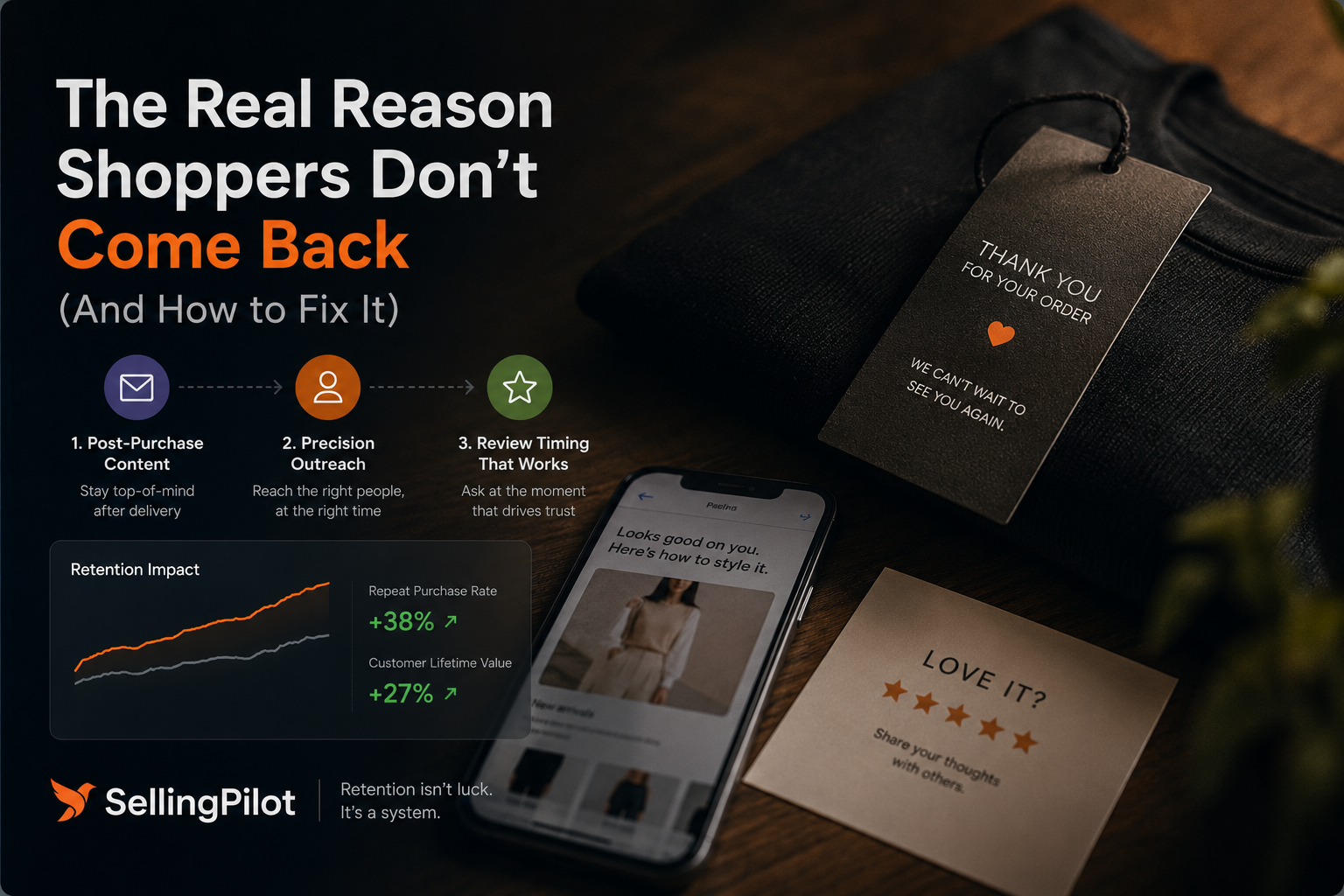
Here are three things that actually move the needle. First: a post-purchase content sequence. Day 7 after a hoodie purchase — send an email. Not a thank-you note. Something like "three ways our team actually styles this hoodie" with real photos. Day 21 — a short note on fabric care. Not selling anything. Just helping her get more out of what she already owns. Day 45 — "this piece has been one of our most-worn items this month, here's how people are wearing it — and a few new styles you might like." Every one of these emails is doing the same thing: helping her fall in love with what she already bought. And falling in love with something you own is the most natural setup for buying the next thing. This logic is simple. But executing it well — the right timing, the right voice, the right content — takes real design.
Second: right-person, right-time outreach. Not mass blasts. Not every customer needs the same message at the same moment. Someone who bought a summer dress and someone who bought a winter hoodie have different repurchase windows. Someone who viewed the same product three times without buying needs a completely different message than someone who converted immediately. The right content, to the right person, at the right time — that's what precision outreach actually means. This sounds obvious. But doing it consistently requires a system that tracks individual behavior: what someone browsed, what they bought, when the optimal next touchpoint is. Done manually? It's unsustainable. Done with the right infrastructure? It scales.
Third: the timing logic behind review requests. Reviews aren't that complicated in principle. They're for the next customer, not the current one. Their job is to help a first-time visitor decide whether to trust you. So reviews matter most at the trust-building stage — when a new visitor is still on the fence. But review quality depends entirely on when you ask. Ask three days after shipping and you get "arrived fast, packaging was nice." Because she hasn't worn it yet. Ask two or three weeks after purchase and she has real experience to share. That's when reviews get specific, personal, and actually useful to the next person reading them. When you ask matters more than which review app you use.
As for loyalty programs and referral systems — there's a clear signal for when they're worth launching. When you already have a group of genuinely enthusiastic customers who organically talk about your products, and you want to give structure to that energy. At that stage, a loyalty or referral system is an accelerator. It amplifies something that already exists. But without that base? You're building a leaderboard with no players. The tools don't create the momentum. They multiply it.
One more thing worth saying. Clothing is different from commodity products. There's emotional weight to it. A piece of clothing holds memory — where you wore it, who you were when you bought it, what it meant to you at that moment. That's not true of a pack of batteries. The brands that consistently earn repeat customers in fashion aren't just selling products. They're building a relationship history with each customer. Every post-purchase email that actually helps. Every product recommendation that feels like it was picked for her specifically. Every moment where the brand shows it still cares after the sale — that's another layer of that relationship. The relationship is the moat. Not a bigger discount.
A practical summary before we go. If you're running a clothing store right now, don't start by picking an app. Start by identifying where your biggest drop-off actually is. Is it post-purchase silence — someone bought, liked it, and then you never really showed up again? Is it browse-but-no-buy — people are interested but something's stopping the first conversion? Or is it one-and-done — solid first purchase, but no clear reason for a second? Each of these has a different fix. Post-purchase silence needs a content sequence that helps customers love what they bought. Browse-but-no-buy needs timely, personalized product nudges at the right moment. One-and-done needs anticipation — knowing what a customer might want next based on what they've already bought, and showing up before they go looking elsewhere. With the right system, all of this runs automatically. You set it up once, and it works at scale. That's what SellingPilot does — it makes "the right content, to the right person, at the right time" something you can actually execute, not just talk about.
Attention is expensive. Customers have endless options. What's rare is a brand that makes someone feel like it genuinely cares about her — not just about the transaction. Give her that feeling, and she comes back. That's really it.